Barre: What is it the fitness trend and is it worth it?

Barre: What is it the fitness trend and is it worth it?

I grew up in a family of dancers. Taking dance lessons until the time I was 8 years old and I’d be lying if I said I still don’t love to dance around from time to time. I think this is the case for a lot of people. Dance is something most people really enjoy letting out some energy with. This is why the popularity of Barre classes have skyrocketed. But is Barre just another fitness trend?

Many people who have a background in dance are looking for that same structure and technique that they are accustomed to with dance classes. Even for those who don’t have a dance background, think dancing is fun. And they are right, it can be a great way to change up your workout routine!

WHAT IS BARRE?

I think many of us have a very vague idea of what Barre is. This was actually started in the 1930s, when Lotte Berk brought it to the public. She was a modern dancer for the time and wanted to bring this kind of exercises that emphasized isometric movements and control for the general public. Many of her dancers at the time had already experienced this, but she wanted to make it widespread so that people of all ability levels could try it.

For today’s world, the class has strayed from a traditional ballet class and has pulled from other popular methods of exercise such as Pilates and Yoga. Making Barre a hybrid fitness trend.

Learn about pilates.

The workouts provided in Barre classes are a challenge. If you have ever seen a ballet or been in a ballet class, you know just how difficult the technique and bodily demands can be. Don’t let this scare you off. The classes are much more tailored to help beginners ease their way into each exercise.

A typical Barre class is set up is by going through each muscle group and burning it out using a series of low impact, but high repetition, exercises. In addition to this muscular endurance work, the class also works in some flexibility training as well.

The important thing to know here that it is not a ballet class. You do not have to be a trained dancer to try it and it is just like starting any other fitness class out there. You will be guided by an instructor the entire time and will get the group workout atmosphere.

WHAT ARE THE BENEFITS OF BARRE?

You may be still wondering why on earth you would do this if you have no background in dance and are just looking for a new workout. There are actually many benefits to doing a workout of this type. Similar to Pilates, this type of workout is going to be mentally engaging as well.

Also placing a big focus on technique, you will have to be heavily concentrated on the task at hand. This may be just the workout you need to get that mental break from your day job.

Barre classes are also a great way to form a community around your workout routine. If you hate working out alone, this might be a great thing for you to try. You can bring along your friends or make new ones a the class.

Not only will Barre be a place for you to bond, but you will have an accountability aspect.

The benefits are not all mental, there are a lot of physical benefits to doing a Barre workout as well. This is another fitness trend that places a large focus on training the core. The benefits associated to Barre are numerous, but perhaps two of the most important are improved posture and balance.

WHAT ARE THE DOWNFALLS OF BARRE AS A FITNESS TREND?

If you have read any of our other fitness trend articles, the drawbacks of Barre might not surprise you.

As we have discussed in previous posts about fitness trends, the improvements in strength from Barre are limited to the weights and reps you use. Because it is often bodyweight or low weight, you are limiting yourself to the muscular endurance phase. There will be limits to how much strength you can build through this kind of workout.

It may not get you to your goals. Similar to a lot of other exercise classes, they are only working in one lane. You are not able to vary your workouts or what phase you are working in because you are confined to the selection of the instructor. This is fine if this is built in to a well-rounded program with cardio and strength, but it is something to consider when planning your week of workouts.

There is little-to no challenge for your heart rate. I am not saying that every workout has to get to the peak of your VO2 Max. However, this does need to be built into your exercise routine in order to improve your cardiovascular health in the long run.
PILATES: WHAT IS IT? SHOULD I BE DOING IT?

PILATES: WHAT IS IT? SHOULD I BE DOING IT?

Just like finding the perfect outfit to wear, picking out the right exercise method to fit your lifestyle and goals is tailored to the individual. Due to people’s different goals and a wide range of interests there are a plethora of fitness classes, trends, and workouts available to the public. HIIT workouts, circuit training, pilates and more.

Exercising is for you and your body to make you feel your best. Just like putting on the perfect outfit! Not only does the exercise method have to match what you want to achieve, but you also have to enjoy it. If you loathe your workout it just gives you an excuse to skip it. It can be tough to find this perfect fit when it comes to exercising. Did you know that your personality plays a huge role is this?

Pilates has been one of the most popular fitness trends not only because of physical benefits, but because of the mental relaxation as well. The question is, is this just a craze? Or is it what you are missing in your workout routine? Let’s dive in and discover a bit more about Pilates.

WHAT IS PILATES?

Although Pilates has really become popular amongst celebrities and gyms everywhere, it has been around since the 1920s. Named after Joseph Pilates who founded the practice, Pilates focuses on specific exercises and movements coupled with a focus on breathing. It also puts emphasis on stretching while developing strength, stability, and balance.

We often talk about how important these factors are in your workout routine. And they become increasingly important as you age. Read more on exercising as you get older.

In fact, “Contrology” was the original name of the practice because of this focus on how you must control your body through breathing and throughout the movements. Many have compared Pilates to yoga, but with more fluidity through each pose or exercise. The biggest focus here is on technique and doing the movements precisely.

Classes usually range from about 45 minutes to an hour and go through a sequence of poses without holding as yoga does. This offers more of a challenge to the body with breathing techniques and engaging almost all of your muscles as you go through many of the poses.

There are different forms of Pilates of which the two most common are Reformer and Mat. Reformer uses equipment such as resistance bands, foot pads, a moving carriage, and straps all on one apparatus. Mat is simply that. It is done on a yoga mat with just your body as you are guided through the exercises. This is generally more accessible to people through video services or at-home Pilates.

BENEFITS OF PILATES

Pilates has a big following because of its’ emphasis on core strength and using body and mind in alignment through the class. Many have seen this as a great transition into the exercise realm when coming from classes like yoga.  There is a large draw to it for these reasons.

Other benefits include the focus on improving posture and flexibility and a big one is that it is a form of low impact training.

As discussed earlier, it is important to find an exercise mode that is suited for your needs and your desires to get active. You should not just focus on why you like it, but why it is beneficial for your body. Evaluate adding Pilates to your workout by deciding if these benefits match your goals. It is also important to look to see if the pros outweigh the cons.

DOWNFALLS OF PILATES

When you look at just the benefits of something it is easy to get a cloudy judgement. On paper, Pilates seems like an amazing way to get active. And it is! But we have to come back to the goals here. If your goal is to drop that number on the scale or see large muscular gains, Pilates may not be for you.

After all, in Pilates you are doing bodyweight exercises. You will not be able to get extreme muscle definition or strength from bodyweight. Even if you add in resistance bands or other equipment seen in reformer type Pilates, you still have a cap as to where your gains can go.

In addition, if weight loss is your goal, Pilates will most likely get you to where you want to be. Incorporating aerobic activity along with strength training will create a more well-rounded workout program. Pilates is a great supplement but doing it as your only form of exercising may not be what your need.

Pilates is a very technical and precise workout. It is not so easy to just jump into an advanced workout without proper knowledge of the exercises and order. This is not uncommon when it comes to different forms of exercises. But when you think of something like a cycling class you can understand the simplicity of hopping on a bike to join a class.

This is not to discredit Pilates, but to ensure that when you are finding the right fit for your workout you consider all the angles!

If Pilates isn’t your thing and you want a more intense form of exercise, maybe circuit training is more your speed. Go at your own pace and pick a couple of exercises to tailor to your time frame.

WHAT NOW?

I would like to emphasize that Pilates has its place in the world and the importance it puts on core and flexibility is spot on. The important things I wanted to bring to light here is that you consider your why when doing a workout. Whatever your reason for working out make sure that is in line with the workout itself, that your are enjoying it, and ultimately it is doing the RIGHT things for your body in the end.

EXERCISE AS YOU AGE: WHAT DOES THE SCIENCE SAY?

EXERCISE AS YOU AGE: WHAT DOES THE SCIENCE SAY?

From the time we are young the importance of being physically active is instilled into our brains. Part of me is still convinced that this is just so kids can get their energy out 😊. The things that are important at this age are developing balance, coordination, mental engagement, and healthy bones. Would you believe me if I told you these are the exact same things that need to be developed as you age? Exercise as you age isn’t different, we just scale the intensity.

I would like to be clear; this article is not to target only those of you seeing the 80s and 90s approaching. The information and science presented here can be applied to every person from 22 to 60. In fact, the decline in both muscle and bone strength begins at age 30! One of the causes is physical inactivity for both of these.

There are a lot of misconceptions out there about what you should be doing with your workouts the older you get. Of course, we need to develop these habits throughout the years of physical activity and exercise. The longer you put it off, the more difficult it is going to be to start. Keep in mind it is never too late, the best time to start is now. The question is, how do you know what you need?

THE KEYS TO DEVELOPING A PROGRAM AS YOU AGE

Our philosophy at the gym tailors to the 3-step progression we want all of our clients to meet as we program for them specifically. These are the building blocks of any program regardless of age, experience, or goals. These include range of motion, stability, and strength, in that order.

Range of Motion

The first is getting range of motion. As we see throughout our lifetime our joint mobility and muscle flexibility pretty much goes down the drain. From desk jobs to years of bad posture and poor mechanics, we see a steady decline. This loss of range of motion is often the cause of many of those aches and pains you experience throughout the day.

The best method here is prevention, but I understand that for most who felt mobile and agile in their twenties, likely didn’t make it a habit to practice great stretching routines. And now at age 50 you are looking in the rearview mirror wishing you had done more.

Good news! As I said, it is never too late to start. If you have been following along with our many discussions about stretching, it does not take much. Stretching twice a day for 20-30 seconds each stretch will definitely help you see the improvements you are looking for. This will also relieve pain in the common areas if done correctly.

Once we are able to gain more flexibility, we can focus on using it to gain more range of motions in the exercises we do. With the use of a TRX or putting a swiss ball between us and the wall we are able to assist in stability to get a greater range of motion. Adding mobility exercises (active stretching) to your workout routine will also expand the movements in your exercises.

The combination of this stretching, mobility, and assistance in exercises is going to set you up for success when building range of motion.

Stability

This next one is going perhaps one of the most important aspects when exercising as you age. One of the biggest causes of falls, dislocations, and injuries in older populations is due to a lack of balance and stability. Therefore, starting early and developing this balance in a controlled setting is very important to your overall health as you age.

One of the ways this is done is through creating instability. This can be as simple as doing upper body exercises using a split stance with the legs. To advance it you can go onto a single leg balance. The older we get, this may be sufficient enough for creating instability.

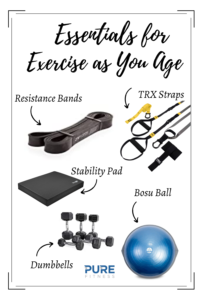
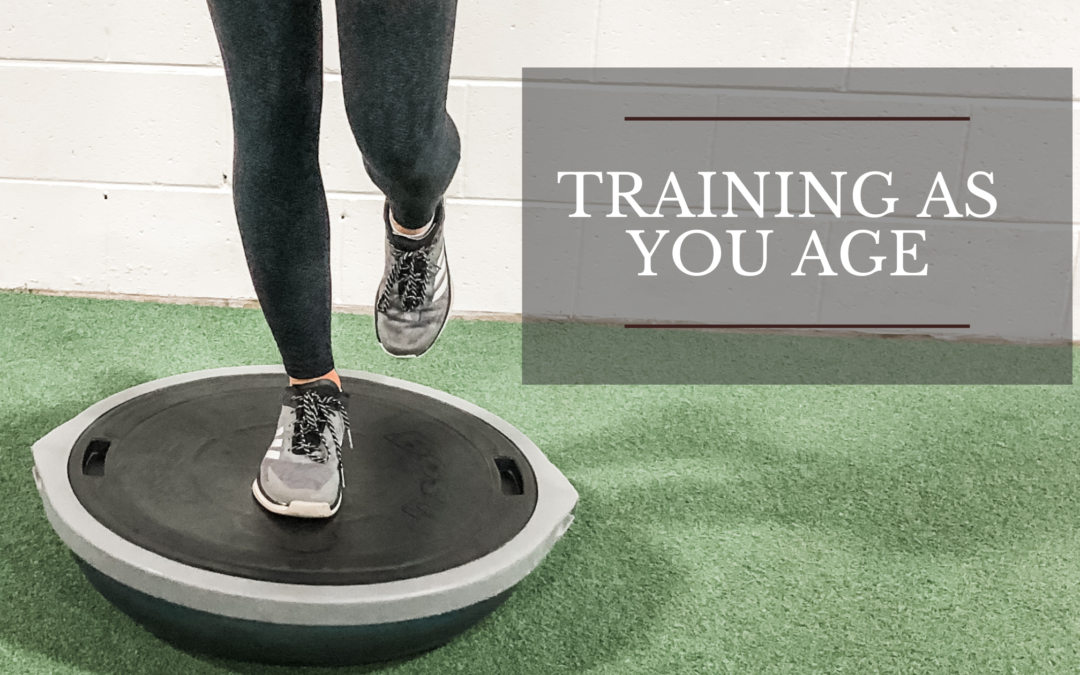
However, if you are starting early and are advanced in your balance technique you can an unstable object. This may include the use of a stability pad or a bosu ball which are our favorites in the gym. Start by using a double leg balance on them, and then as you get better you can move to two.

It is important to note that advancing too much too fast can result in injury. Only do so when advised by a professional. Improving your ability to balance in instable situations will only improve your ability to do so in your everyday life. This could be the difference between feeling healthy or getting a fractured bone.

Strength

Once the flexibility and stability have been established, strength is the next one to be developed within the individual. This is not to say that we stop working on the first two all-together but need to keep working on them as we continue to build strength.

Although much of our muscle strength and power declines as we age, our body’s ability to adapt to resistance training remains the same. Resistance training in older adults has a huge positive impact on bone health and helps adults’ ability to function through everyday activities such as climbing stairs, sitting down and standing, and even reactionary functions.

Just as you would for an individual, it is important to scale the amount of weight to the capabilities of the exerciser. We do not want to overtask the musculoskeletal systems in older adults, so weight selection is very important!

Some of the best exercises for adults in older populations include:

  • Squats (assisted with TRX or a swiss ball if needed) These are great of building range of motion especially in the hips. It is imperative to build strength in this range of motion for functions like sitting in a chair or getting in and out of bed
  • Rows (using a cable machine or resistance bands) These are great for strengthening the back to proper posture and helping to get rid of shoulder pain. Combining these with chest stretching will help the individual improve everyday functioning. Upper body strength can also be built with the use of dumbbells.
  • Core: In the form of a core rotator (read more about it here) or simply incorporating proper core engagement in all exercises, is vital for eliminating back pain. It is important to recognize that using excessive amounts of core bracing (Valsalva maneuver) can illicit various responses due to a raise in blood pressure that can occur. Avoid holding your breath and stop exercising if you feel dizzy or light headed.

OTHER CONSIDERATIONS

For exercising in older adults, it is important to consider the following things, especially if you are trying to create a program on your own. You should consider consulting a physician, no pain, warm-up properly, include strength and cardiovascular exercise, and give yourself rest. Look at the image to the left for more information!

These are all important to note as you venture into the exercise world or continue exercising as you age. But I want to call special attention to the first item on the list. The primary thing to consider is that you are cleared by your physician. Quickly followed by the fact that you are pain free when exercising in your range of motion.

The benefits of being active are immense as you age. They come from not only in walking and aerobic capacity, but in flexibility, balance, and resistance training. Structure your program to include them all. It can be the difference between a sedative lifestyle or living with minimal pain and doing the things you love!

Tabata Workouts: Is 4 Minutes a Day too Good to be True?

Tabata Workouts: Is 4 Minutes a Day too Good to be True?

If you are like me, the first time you heard the word Tabata you thought it was some form of martial arts. Back then, I honestly had no clue what it meant and frankly did not care to know. For those of you who are familiar with Tabata workouts, you know that it is not martial arts but actually a version of HIIT (High Intensity Interval Training) workouts.

It was actually named after the professor Izumi Tabata who was studying higher intensity interval training using Olympic speedskaters who were performing the study on a stationary bike. This was back in 1996. It has now become one the more popularized methods of interval training out there today. But what separates Tabata as a style of HIIT. What makes it so special?

Wait, if you aren’t even sure what HIIT is you should read about HIIT. It lays the foundation for everything you are about to read.

DEFINING TABATA WORKOUTS

The parameters of the original study involved the athletes doing 20 seconds of high intensity and 10 seconds of rest. During the high intensity part of the workout your VO2 max is going to be at 170%. Recall here that VO2 max is the volume of oxygen that is being transferred and utilized within the body during exercises. This 20 seconds on, 10 seconds off was done for 4 minutes.

Through the study, they found that with this method, they were able to achieve similar increases in VO2 max and aerobic capacity as a longer duration of cardio at a steady intensity. They also were able gain anaerobic capacities as well! Exciting results that explain why intervals are used to improve athletic performance.

So, yes, this falls within the umbrella of HIIT training due to its nature of having a section of high intensity, followed by low intensity. However, this one is only for 4 minutes! I mean come on, working out has never been easier right!?

LET’S GET REAL

Alright so Tabata workouts sound like a dream. 4 minutes a day. And you get the same benefits as someone who worked out for an hour? SIGN ME UP.

Sorry to burst your bubble, but this is not entirely the case. Let’s look at the facts here. The benefits from the study were based off of a VO2 max of 170%. Although we cannot accurately measure this at home, let’s compare to the other HIIT workouts we have done. They require you to only be at 90%.  We have already talked about how much effort needed to get there and how difficult it is.

And looking at the Tabata study, they were using Olympic athletes. Chances are, if you are reading this article then you are not training for the Olympics. I mean, if you are then I am honored (I’m looking at you Gabby Douglas). Most of us will probably never come near that level of maximal effort, let alone in the 20 second range. Not to mentioned this was in a lab under very controlled conditions. So really we will probably not be able to do a TRUE Tabata workout.

CAN I STILL GET RESULTS FROM MY TABATA WORKOUTS?

Now that I have just told you none of you are actually doing Tabata workouts, I do want to give you a bit of hope here. You can still do a Tabata-inspired workout! This is just going to fall into the category of HIIT using 20 seconds on and 10 seconds off. You just aren’t going to be operating at that 170% VO2 max effort.

The bigger focus here, as with HIIT, is giving that maximal effort that you have for those twenty seconds of work. If you are able to do that, you will still be able to get a great workout in those four minutes! You can measure this level of effort through your heart rate. Due to the popularity of fitness trackers and the growth in technology this is easier than ever.

I use an apple watch as my preferred choice due to the easy pairing with my other devices and the ability to track different types of activities (including a setting for HIIT).

These are affiliate links. While there is no cost to you when you order through them, I do make a commission. Your support, by ordering through them, is greatly appreciated!

Other options include a fit bit or a polar watch, depending on what look and function you are looking for! Here are links to both.

The benefits here are going to mimic that of HIIT workouts, because as we explained earlier, Tabata workouts are under the umbrella of HIIT. Other benefits include it being so short! Only 4 minutes for a Tabata workout!

HOW CAN I DO “TABATA” WORKOUTS AT HOME?

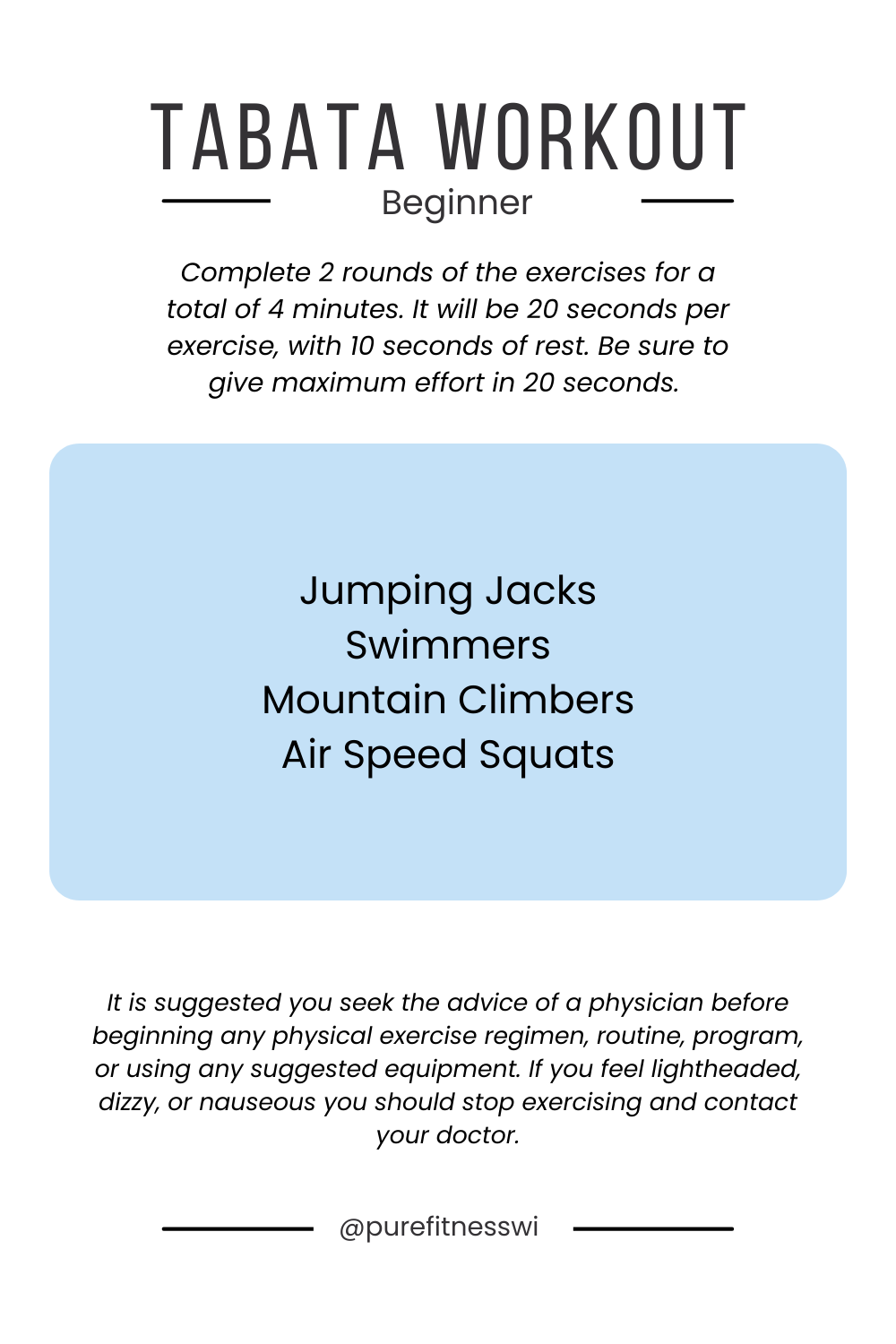
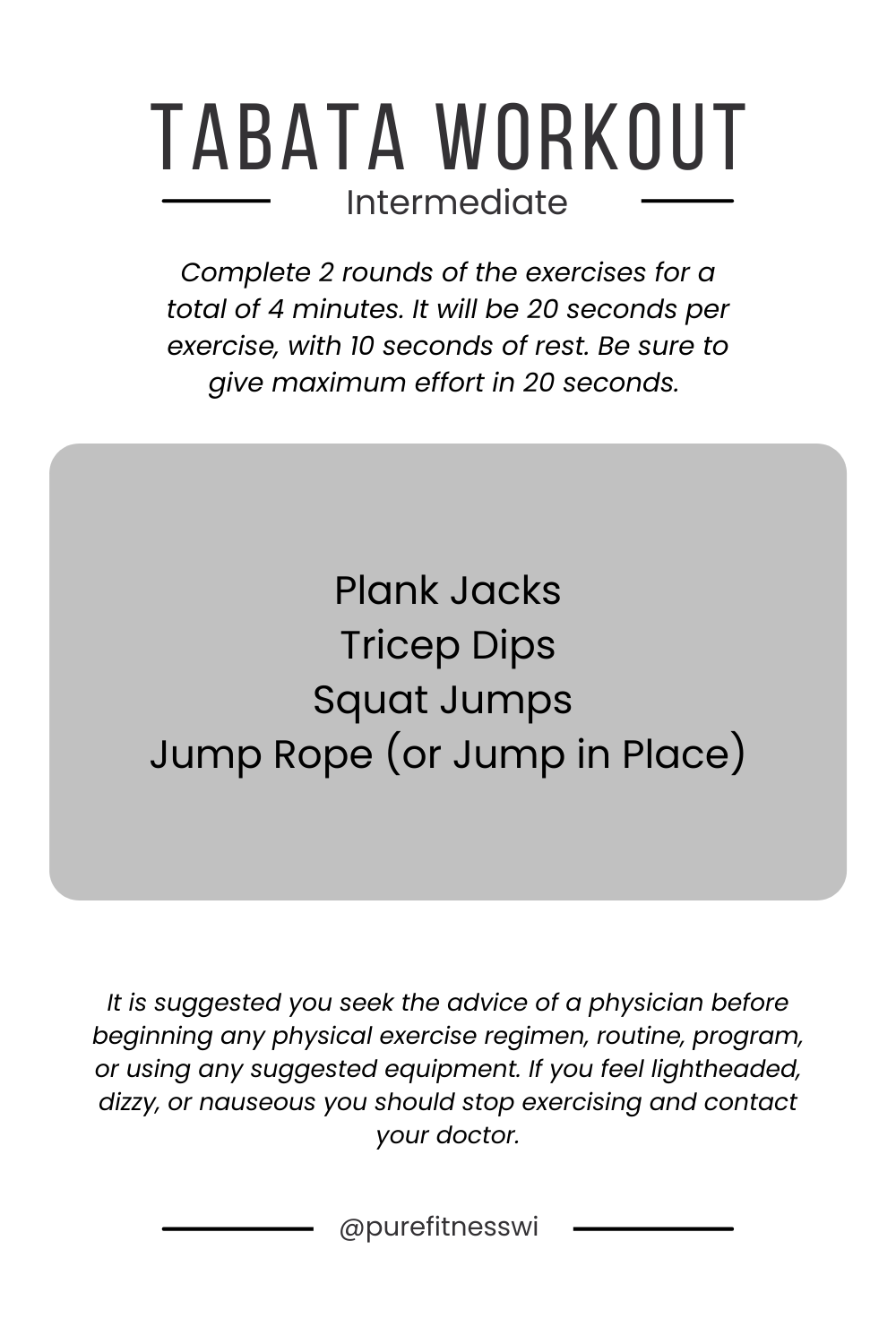
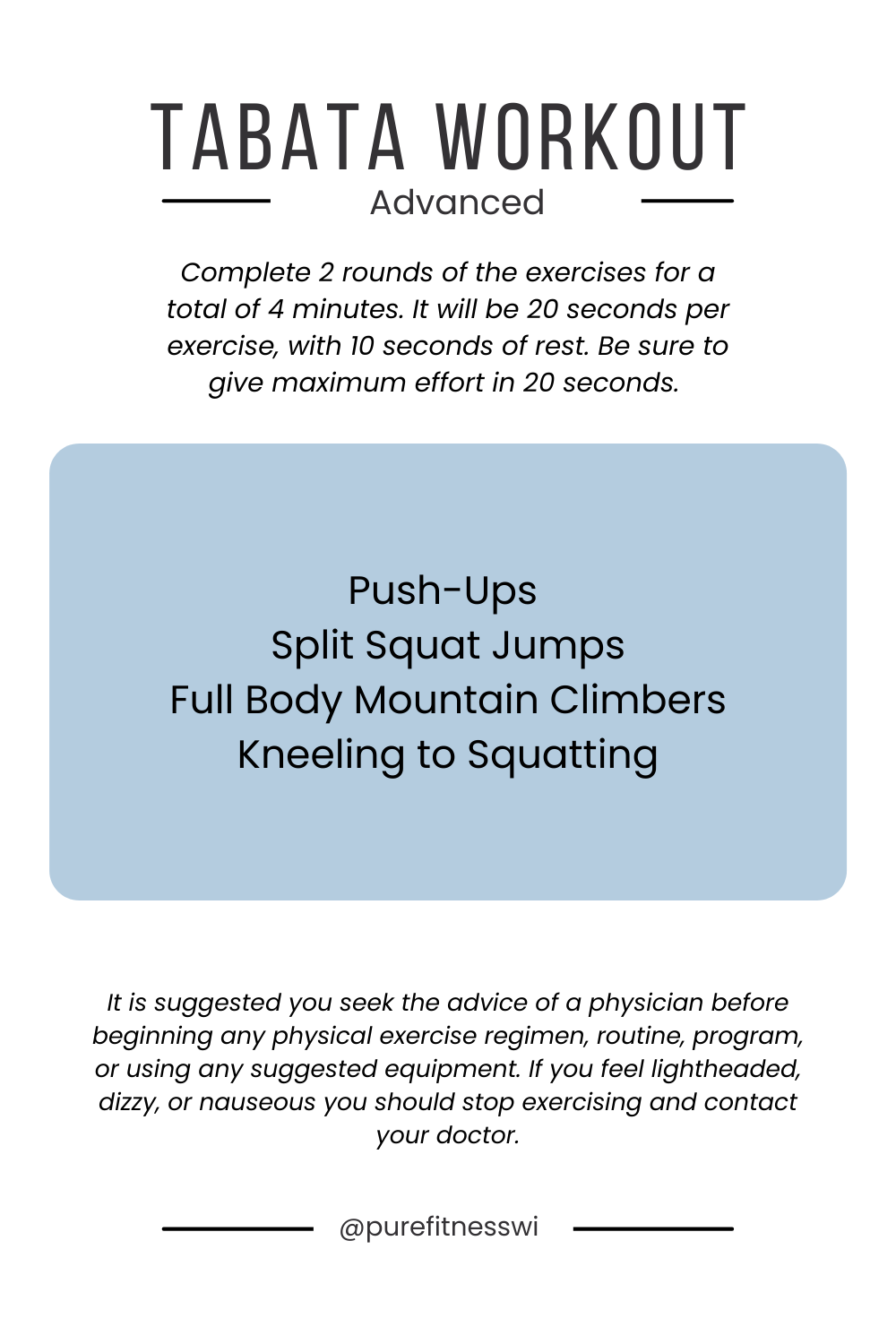
Here are three workouts that can be done at home to mimic the Tabata type style of training. They are going to add in a bit more muscular strength for a total body workout! Keep in mind it is important to give maximal effort in the twenty seconds and rest fully for the 10!

Most of these are not going to require any equipment! However I do recommend having these items on hand before you begin.

A Yoga Mat or a Large Exercise Mat for comfort when doing your at-home Tabata workout. Especially if you are on a hard wood floor these are a life saver. The yoga mats is the most common and cheap, but if you are an avid at-home gym go-er, you might want to consider investing in this larger mat!

For myself, I like to bring this Hydroflask Water Bottle, this Lululemon Headband, and of course my airpods for picking the about two songs to crush my 4 minute Tabata workout. I love these items because the water bottle keeps my water cold, the headband keeps the sweat out of my eyes and my airpods keep me going even when I’m tired!

You will also need this Jump Rope for the Intermediate workout because not only does it have comfortable handles, but it is adjustable as well! I would recommend this Stability Pad for the advanced workout for the kneeling to squatting exercise. This one can be rough on the knees even with a yoga mat!

It should be reiterated that this is not actually a Tabata workout! This is just a style of HIIT that you can try at home! Get creative with what you want to put into your workouts and make them enjoyable so you can get the most out of your workout!

As with HIIT training, it is important to recognize that you should not do a Tabata workout everyday. Even in the original study, the athletes did not perform the workout every single day. This is a great method of exercises to fit in on the days that you are not strength training and need a cardio workout, but don’t have a ton of time!

Circuit Training: Fact VS Fiction

Circuit Training: Fact VS Fiction

Ever wonder what all these fitness trends mean? Circuit training is probably one of the most used fitness trends that you will see applied “differently” at various establishments. Let’s break down circuit training – what you need to know before starting your workout.

When you think of a great workout, what do you think of? Most of you would answer that question in three ways. One, you work up a great sweat. The mindset of “if I am not drenched in sweat by the end of this workout I have not done enough”. Two, it is fast paced with little time for water and rest. You envision yourself pushed to the limit. Three, you are sore beyond belief. You are barely able to walk or even do everyday activities the next day.

As a lot of us have been taught, a great workout results in those three things, or at least one of them. It doesn’t matter what we do, how many sets we do, what our form is like, or any of that. This has been the way we have been taught. That attention to detail and the individual doesn’t matter as long as everyone leaves believing they have accomplished one of those three goals. Better yet, all three of them.

But are those the right goals? Or are there other things for you to consider?

DEFINING CIRCUIT TRAINING

All circuit training means is the format of your workout. It is grouping together a handful of exercises in a list, going through them, and then heading back to the top. You move efficiently from exercise to exercise and your larger rest period will come at the end. In fact, HIIT training can be done in a circuit format.

To build a circuit, you would group together a couple of exercises, say an upper, a lower, and a core. Or you could create a muscle group burnout and do a couple of lower body exercises to condense your leg day into a focused circuit. If you search circuit training on the internet, they will tell you it has to be full body. THIS IS FALSE. Targeting one muscle group can still be a circuit and it is actually an effective way to overload.

If your focus is on muscular strength, you might create a shorter circuit of only 5 exercises with a bit more rest in between each exercises and round. You would increase the weight used for a moderate to low rep count.

If your focus is more muscular endurance, you would manipulate the rest intervals to be shorter. You might also choose lighter weight and even body weight exercises for a high rep count.

WHERE CIRCUIT TRAINING GOES WRONG

Often times the popularized group fitness classes focus on how they can get your heart rate up through cardio intervals and sprinkle in some resistance. The emphasis is put on how fast and hard you can push yourself, not on how you are performing the exercises.

This is a dangerous mindset to have for every workout you do. It increases the likely hood of injury (minor to major), it encourages bad form or creates bad habits, and it limits your body’s ability to adapt and recover.

Do not get me wrong, I understand that these group classes can be effective. Circuit training has its place in the world and in your workout routine. I am not here to bash the workouts you have come to enjoy. I myself have found these group circuit training classes to be fun, challenging, and effective for getting a great workout in.

However, these exercises routines are taxing on your body when they are done everyday. They tend to rely heavily on one energy system. Typically they do not focus much on strength training in an intentional way with correct form. There is not enough emphasis on exercises selection to build range of motion, stability, and strength, which are keys to a well-rounded and balanced program.

In is important to note, that circuit training can be used in a less intense manner. You do not have to kill yourself at a high tempo pace. I recommend alternating your workout tempo or speed for the best results physically and increase your consistency.

BENEFITS OF CIRCUIT TRAINING

Circuit training is effective and efficient when done correctly. In fact, I use circuit training in the gym almost every day. Tempo and repetitions are adjusted to purposely work on different energy systems.

The great part of doing a circuit for your workout is you get to choose what you want! If you want to focus on upper, lower, total, or core you can create that circuit to do just that. If you are searching to build your muscular strength or endurance, you can make it focused as such. The possibilities are endless when deciding where you want your circuit to take you.

The other great part about circuit training is it can fit in the time slot you set. If you have twenty minutes you can do one circuit, 4 times through! Or if you have an hour to workout, you could even do 3 circuits, 3 times through! It is completely under your control.

As I said before, the possibilities are endless for circuit training. You can create thousands of different combinations and types of workouts with all the freedom it entails. The important thing is to do the exercises right and create a balanced program!

WHERE TO START

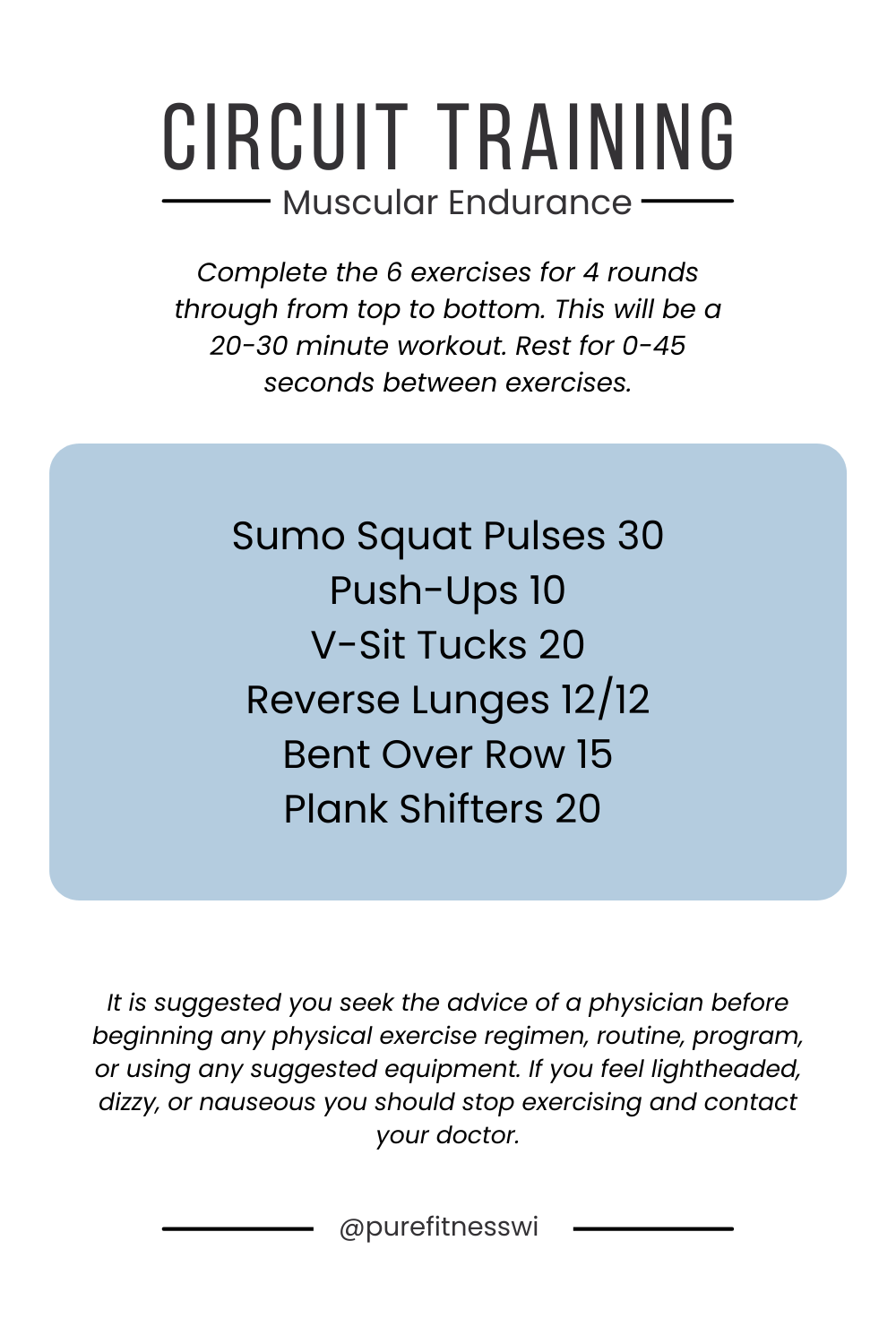
Here are some options for circuit training that build in the correct balance, still give you a great workout, and will develop you in every area essential for overall well-being! I have split these up into muscular strength and muscular endurance circuit training workouts. 30 minutes each. They are total body workout, but as I said you can develop these into anything you want. Scroll down to download each workout.

Muscular Strength

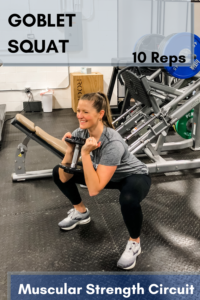
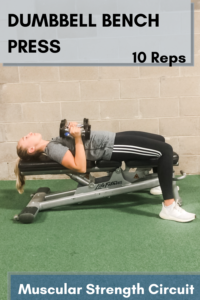
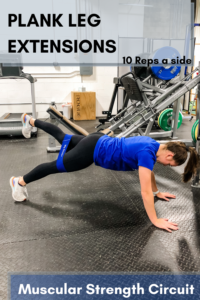
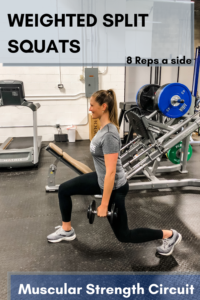
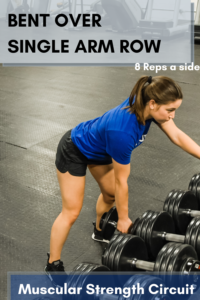
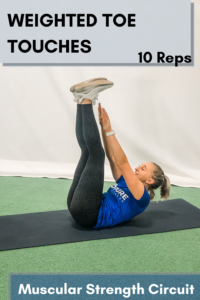
This is a circuit of 6 exercises and you will go through 3 times for a 20 to 30 minute workout. Your rest periods will be about 90 seconds in order to stay in the muscular strength window. You will want to weight these exercises a bit heavier because the rep count is lower! Shop dumbbells and a hip circle for leg extensions.

Muscular Endurance

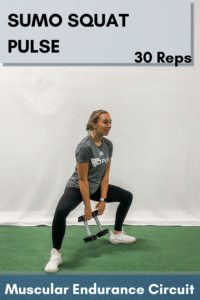
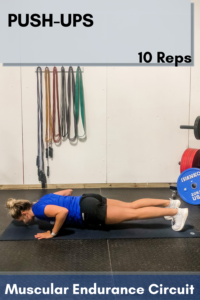
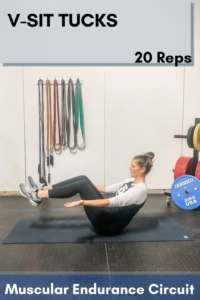
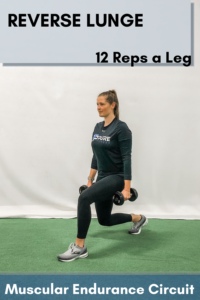
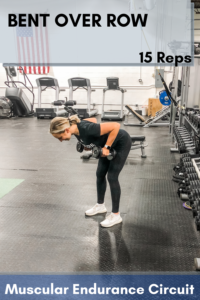
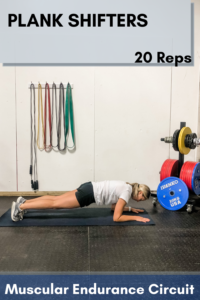
For this one it is going to be 6 exercises again, this will be for 4 sets total. These are going to be higher rep and are going to have shorter rest periods in order to work in the muscular endurance stage. These rest periods are going to be in the 0-45 second range. These should be weighted moderately.

These are just examples of how you could build a circuit based upon every energy systems. As I stated, the sky is the limit for how you can create a circuit. Just be sure to be intentional with your programming and have a goal in mind when deciding what you want out of your workout. You can create a difficult, sweaty, and effective workout while still maintaining great form and proper programming!