BEST EXERCISES FOR CYCLISTS

BEST EXERCISES FOR CYCLISTS

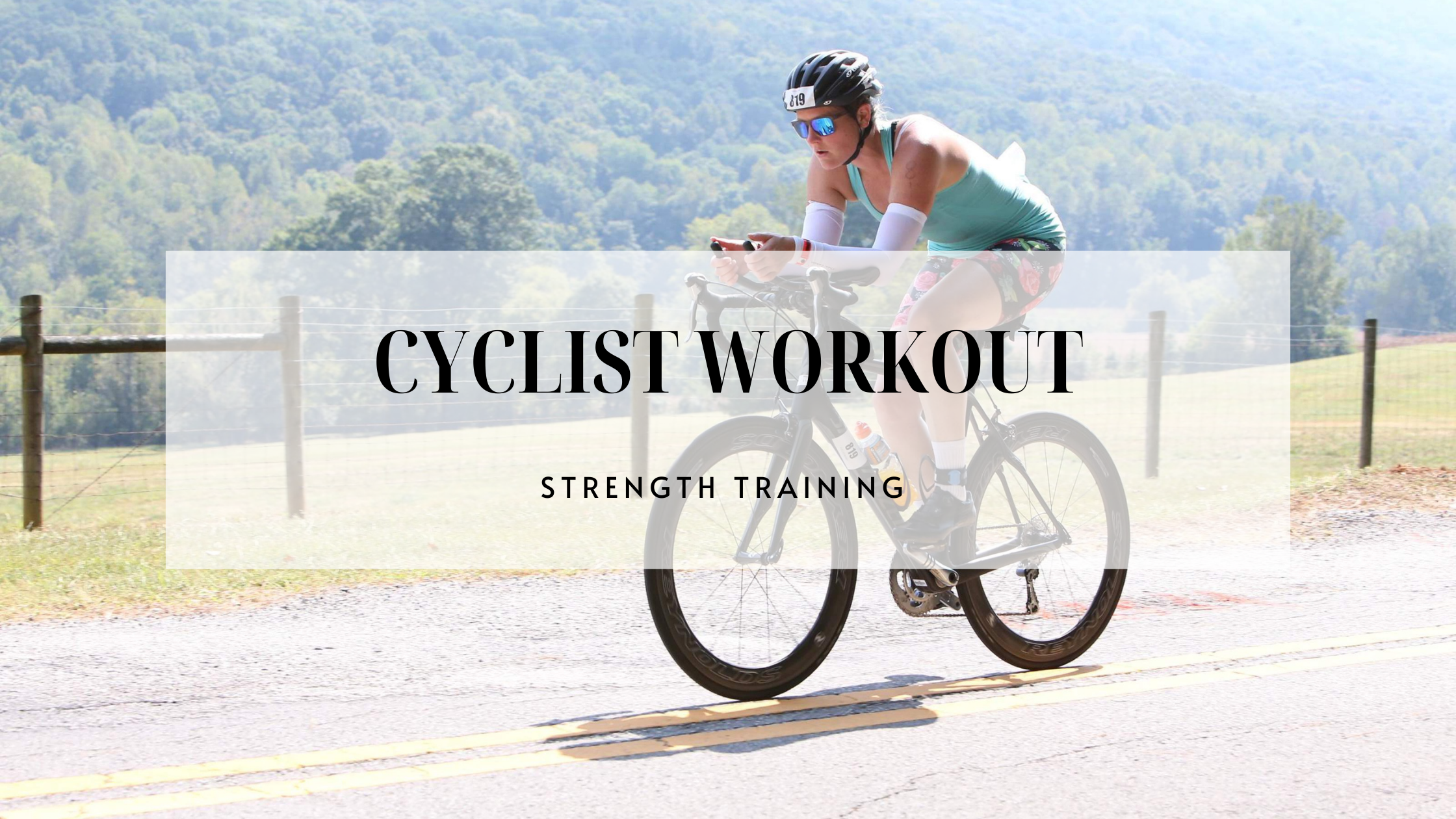
I found cycling because I have a great friend who told me I should do an IronMan. And the amazing thing that happened was that I fell in love with it. Sure there were days I didn’t want to ride, but man trying a new sport was exciting. You know what happened next. I wanted to be better. Naturally, I turned to what I knew – strength training.

Lucky for me I had the knowledge base and the understanding that getting better at cycling as a non-professional wouldn’t take a detailed analysis of my bike fit. Or some great cutting edge gear. Or even a technical coach. No at this point the biggest bang for my buck (money and time) would be strength training.

Don’t get me wrong. There is a time and a place for bike fittings, gear and coaching. But as a novice what I needed was to strengthen and condition my body for the sport. After all, even the pros are still strength training between all their training rides, fittings and coaching.

WHY SHOULD CYCLIST STRENGTH TRAIN
reasons to use personal trainingHere is the number one reason competitive cyclist need to strength train. PERFORMANCE. It doesn’t matter if you are competing to win or competing to finish, strength training should be a mandatory part of your training plan.

Without strength training you are at risk for injury. A properly written and executed training plan will work to keep your body’s muscular system in balance as it handles the work load of training.

Let’s be transparent here, not all training programs are made equal. A bad program or poor quality of reps (incorrect muscle firing patterns) will have a negative impact. Increasing risk of injury or prevalence of pain. Finding a specialist to work with you directly or to at least get you going is an absolute must.

Strength training is meant to build power. Power that we can harness in sport to improve our performance. We can argue that the stronger your legs are the more power you can output. Therefore the faster you can be. This is true. But the catch is that you have to be strong and have incredible endurance. Two things that are a little contraindicative.

Your training plan should cycle to account for off-season, in-season changes. Defining a time that is for building strength and a time that is for building endurance. Helping you to peak at the moment of performance. When you are your strongest, with the most endurance and the healthiest (no injuries or risk of injury).

BEST EXERCISES TO WARM-UP FOR CYCLING
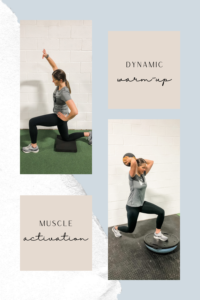
how to warm-upThere are three common ways we are suppose to warm-up. Foam rolling, muscle activation and dynamic warm-up. Is one better than the other? Depends on who you ask.

In my opinion, for the average person, it doesn’t matter. What matters is that you find something that you will do consistently. Because let’s face it most people are NOT warming up. And believe me, I have been there. Sometimes the idea of  warming-up seems harder than the workout.

The goal of a warm-up is to raise your body temperature and therefore you muscles so that they can be responsive under the stress of exercise. Part of this process should be “awakening” or activating the muscles you want to help you perform. So in the case of biking we want to really warm-up our lower body and core. And typically this takes around 10 minutes.

Personally I prefer to use whatever type of warm-up I am feeling for the day. I LOVE a good dynamic warm-up, but I would be lying if I said I did that every time. I would say quite often when I am cycling indoors I will foam roll for 5 minutes and then take the start of my workout slow to increase my body temperature. And every so often, when I am having some nagging discomfort I use muscle activation to relieve the discomfort and ensure proper muscle firing patterns in my workout.

Take a look at the these three styles of warm-ups:

  • Foam Roll: glutes, IT band, quads, hamstrings + calves
  • Muscle Activation: focus on the glutes, hamstrings and core
  • Dynamic Warm-Up: standing hip circles, lunged rotation, flexion and extension, single leg rdl, standing swimmers and standing chest rotations.

If you are looking for a less running specific warm-up routine to use on strength training days or just to get your body moving check out this blog.

BEST EXERCISES TO STRENGTH TRAIN FOR CYCLING
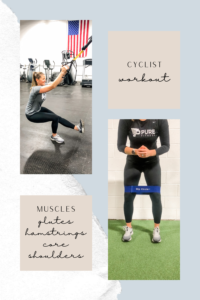
muscles in a cyclist workoutI have put together two strength sets, legs + core, you can try incorporating into your weekly training. My intention was to provide you a challenging program that can be done body weight or with resistance. You can also vary the repetition numbers based on your training situation.

There are a few important pieces of information you should have in order to make the most out of your strength training. Well there are actually a lot, but I am going to try and give you a brief overview of the essentials. If you want more then it is time to get yourself a personal trainer 🙃. Let’s start with some guidelines for training.

Quality over quantity. Any good training program can give poor results if it is not executed correctly. What does that mean? Proper form and muscle loading is the basis of any program. If you can’t fire your glutes you will never get the benefits of a reverse lunge, a back squat, a single leg RDL and more. Strength training is purposeful, going as hard as you can without purpose will end you in injury or frustration or both.

Here is my tip – most people are NOT appropriately using their glutes and hamstrings while cycling. Using a training program that will help you access those muscles while cycling will be a game changer.

Muscular endurance verse muscular strength. Depending on the distance you are training for your strength program will look slightly different. To keep it simple the longer the distance the more muscular endurance you need. To train for muscular endurance your rep count and overall volume is going to be higher. I generally look in the rep range of 15-20.

Not to confuse you, but a well designed program for a long distance race will still include muscular strength. It boils down to periodization to ensure that an athlete peaks at the ideal time. Yes, you are an athlete. You don’t have to be a pro to be an athlete, or have played a sport in college. You just have to approach your athletic hobby with the mindset of an athlete. And if you are reading this, then I would hazard a guess that you are in-fact an athlete.

Consistency. Don’t read this and think oh I am going to be stronger and faster and a better cyclist by next week! Results will come with consistent, long-term practice. Nothing happens overnight.

If you want to read a little bit about how you can use various types of interval training for your strength training check out our blogs on HIIT and Tabata. When used correctly, as described in the article (probably not what you are currently doing), they can vast improve someones cardio vascular capabilities.

And one more thing … even athlete need an off-season. You should have time built in to work on your strength imbalances or weaknesses. Time to give back to your body so that you can push it further next time. A lot of progress (read: faster + healthier) is made by gaining muscular strength in the off-season and translating that newly built strength into muscular endurance. Periodization.

If you are a triathlete check out my other blog on strength training for running.

CYCLIST LEG WORKOUT

  • Glute Bridge to Hamstring Curl on Swiss Ball
  • Deep Squat with Lateral Move to Step-up with Knee Drive
  • Single Leg RDL to Reverse Lunge with Knee Drive
  • Hip Circle Back to Front to TRX Single Leg Squat
  • Cable Squat to RDL

CYCLIST CORE WORKOUT

  • Swimmers
  • Prone Press
  • Alternating Super Mans
  • 4 Way Plank Extensions
  • Side Plank Clam Shell

BEST EXERCISES TO COOL DOWN FROM CYCLING

This is probably the second most skipped part of training. First being the warm-up. But I give this second place because we all know that often time the best feeling after a hard workout is to lay in out position and stretch.

So many injuries or set backs I see are completely avoidable. Part of avoiding them is cooling down. Give back to your body after you just demanded so much of it. You can hit all those muscles I talked about above (see warm-up) with a foam roller again or you can do static stretching.

Your goal here is to release muscular tension. Throughout your workout your muscles were contracting to produce the movement, now we want to lengthen them. Doing so will speed up your recovery between rides and workouts, decrease risk of injury and decrease your soreness.

We have a lot of information on our website about recovery. Here are just a few of my favorites: favorite cool down + 5 recovery tools to use.

WRAP IT UP

Keep in mind that the workouts I gave you are a starting point. Most of these exercises were focus on the concentric phase of muscle contraction. A well balanced program is going to include all three muscle contractions (concentric, eccentric and isometric). It will also work in all three planes of movement (sagittal, frontal and transverse) to ensure quality range of motion, stability and symmetry.

Hopefully you can start implementing some of the exercises or principals in your training program. If you need any help in getting started or taking your training to the next level contact me below 😃.

Fit Finds: The Ultimate 2023 Fitness Gift Guide

Fit Finds: The Ultimate 2023 Fitness Gift Guide

Welcome to the world of fitness and wellness gifting! As we gear up for 2023, it's time to start setting goals and looking for resources to help us succeed. Whether you're a fitness fanatic or seeking the perfect gift for one, our Ultimate 2023 Fitness Gift Guide is...
read more
The Power of Social Proof In Personal Training

The Power of Social Proof In Personal Training

In the world of personal training, where trust and credibility play pivotal roles, the concept of social proof functions as an authentic way to connect with your audience. Social proof, the influence created when individuals see others engaging in a particular...

read more
fitness articles
lifestyle articles
nutrition articles
golf articles

SUBSCRIBE

Click to sign-up for weekly information and offers.

DISCLOSURE

We are a participant in the Amazon Services LLC Associates Program, an affiliate advertising program designed to provide a means for us to earn fees by linking to Amazon.com and affiliated sites.

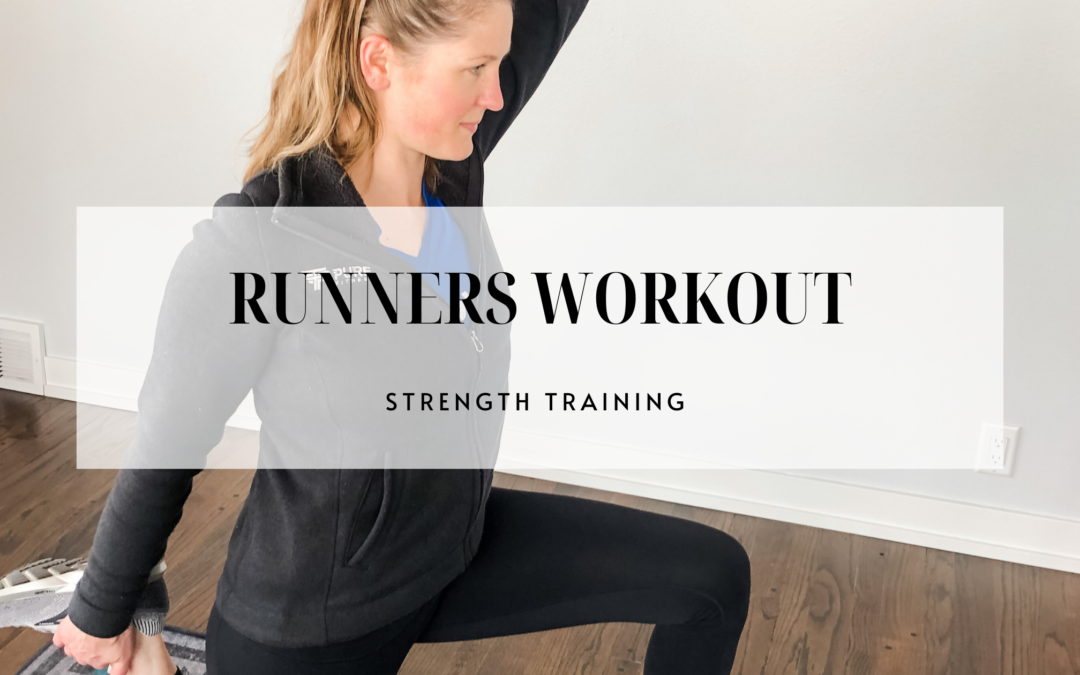
BEST EXERCISES FOR RUNNING HEALTHY + FASTER

BEST EXERCISES FOR RUNNING HEALTHY + FASTER

I am a self-proclaimed “non-runner” runner. My love isn’t for running, but for the feeling of accomplishment. I am not passionate about running, but rather the discipline it takes to get better. Running is my outlet because it is available, it is challenging and I am struggling to get better. That’s where strength training for my “non-runner” running comes in.

After years for sprinting out the door, trying to better and faster than the day before I got myself an education, Literally. I got a degree in Exercise Science. I learned the value of strength training to improve running performance and the balance between volume work and interval training.

WHY SHOULD RUNNERS STRENGTH TRAIN

running ironman madisonThere are many reasons why runners and “non-runner” runners should be strength training weekly. But here are my top three:

  1. Injury Prevention. I cannot count the number of running related injuries that come from OVER running. Imagine if those people just swapped 2-3 workouts a week for strength training. They likely never would have gotten shin splints or patellar tendonitis. Including strength training in a running program will help protect the body and lay the ground work to fun faster and longer.
  2. Muscular Stability and Strength Balance. Repetitive actions, such as running, put your body in a box. Demanding the same muscles and often ignoring others. Overtime the balance in your muscular system will become uneven and pain and discomfort will start before, during and after running. This will limit your ability to run. It can sideline runners for months and the pain could creep into every part of your life. Through strength training you can ensure proper muscle firing patterns and strength symmetry to keep yourself moving.
  3. Performance. You will not, I repeat you will not, find any high level runners that are not strength training. They can be sprinters, marathon runners, triathletes, professional, collegiate or aspiring. They are all strength training. But you may need to adjust your perspective of strength training. Although all of these athletes are running, they will strength train differently targeting muscular endurance or muscular strength based on their sport

BEST EXERCISES TO WARM-UP FOR RUNNING

foam rolling

There are many ways to warm-up and I am not here to tell you my way is the best. Instead I want to give you some options to explore and a little bit of science. First, let me tell you that warming up might take a few extra minutes, but you will feel better during and after.

The goal of a warm-up is to raise your body temperature and therefore you muscles so that they can be responsive under the stress of exercise. Part of this process should be “awakening” or activating the muscles you want to help you perform. So in the case of running we want to really warm-up our lower body and core. And typically this takes around 10 minutes.

I know you are now like this woman is crazy. She wants me to add 10 minutes on to my workout. Well if time was no issue that would be great. But you can pair one of the next three options with a SLOW start to running. Increasing your speed for the first 5 minutes of your run.

My preferred way to warm-up is through dynamic movement. I slowly increase my heart rate, body temperature and focus on using specific muscles. Although sometimes a good foam rolling session is what I need to get my feet to the street 😜. And at the very least I will do some muscle activation. Take a look at these three ways to warm-up.

  • Foam Roll: glutes, IT band, quads, hamstrings + calves
  • Muscle Activation: glute bridge, figure 4 glute bridge, deadbug, bear stance to plank
  • Dynamic Warm-Up: reverse lunge + rotate with knee drive + toe lift, lateral lunge + twist with knee drive + crunch, forward lunge + side bend with knee drive + toe lift.

If you are looking for a less running specific warm-up routine to use on strength training days or just to get your body moving check out this blog.

BEST EXERCISES TO STRENGTH TRAIN FOR RUNNING

I have put together two strength sets, legs + core, you can try incorporating into your weekly training. My intention was to provide you a challenging program that can be done body weight or with resistance. You can also vary the repetition numbers based on your training situation.

There is a lot I want to say about selecting weight and repetitions, but it’s just too much. I’d be writing for days and there are textbooks and research papers you can read if you really want to know. But I do want to give you a few general guidelines.

First, quad dominance is extremely common in runners. Your strength program should help you avoid or manage that. That is why the exercises I have laid out show a huge focus on hamstrings and glutes. There is also a high demand on your hips and calves so I have incorporated additional movements that may make you feel uncoordinated, unbalanced or just slow. Take your time, it get’s easier.  And finally, we are trying to work in multiple planes of movement and muscle contractions to increase your stability so you can be faster and healthier.

This all goes back to what I was talking about above – muscle firing patterns and strength balance.

Second, if you are training for a long distance race you are going to want to be working in muscle endurance. That means your rep count will be higher and your weight will likely be lower. Think reps 15-20 and find a weight that allows you to finish all your reps. And if you are new to strength training, regardless of distance, start  with 8-10 reps and no weight. Make sure you are using the correct muscles and form.

That last bit goes for everyone – quality over quantity. Any exercise, no matter how great, done incorrectly (especially done incorrectly repetitively) will lead to an injury at some point.

Third, don’t trick yourself into thinking a week of strength training should change your mile splits. Results will come with consistent, long-term practice. Nothing happens overnight. But, every runner I have worked, with who started incorporating weekly strength training, felt better within a few weeks. Hold on to that thought as you hobble around after these workouts 🙃.

If you want to read a little bit about how you can use various types of interval training for your strength training check out our blogs on HIIT and Tabata. When used correctly, as described in the article (probably not what you are currently doing), they can vast improve someones cardio vascular capabilities.

And one more thing … even runners need an off-season. You should have time built in to work on your strength imbalances or weaknesses. Time to give back to your body so that you can push it further next time. A lot of progress (read: faster + healthier) is made by gaining muscular strength in the off-season and translating that newly built strength into muscular endurance. Chew on that.

RUNNERS LEG WORKOUT

  • Single Leg Hamstring Curl – try going slow on the extension to make this an eccentric exercise, add a single leg glute bridge to take it to the next level.
  • Side Step-Up with Knee Drive + Toe Lift to Curtsey Lunge – be sure to control your leg/body back down to the ground and really feel your glutes burn.
  • SL Box Squat – once you can control the entire phase down, try going slow and make this an eccentric exercise.
  • Bulgarian Split Squat with Rotation – focus on strength and stability in the bottom position as you rotate.
  • Hip Circle to Reverse Lunge with Knee Drive + Toe Lift – keep your upper body still as you perform the hip circle, really brace your core to maintain balance.

RUNNERS CORE WORKOUT

  • Runner Extensions – purposeful movements at a moderate pace, increase band resistance or reps as your strength increases.
  • Side Plank Rotate, Raise + Crunch – push the ground away through your elbow and focus on the connection of your core from hips to shoulders.
  • Bicycle to Flutter Kick – feel your low core and hip flexors fire as you keep your spine neutral and core engaged.
  • Negative Flutter Kicks – an eccentric and concentric load for your core + hip flexors, try to get as many flutters as you can before your feet get to the ground.
  • Bear Stance Kick Up + Kick Through – focus on keeping your pelvis stable as you kick up and feel the rotation through your belly button as you kick through.

BEST EXERCISES TO COOL DOWN FROM RUNNING

Now you have read everything so far. I’m impressed. That tells me you are serious about taking care of your body as supporting your habit of running. PLEASE PLEASE PLEASE cool down after running. I know I have made a big deal about every phase of running, but I have to. So many of the running related injuries or set backs I see are completely avoidable. Part of avoiding them is cooling down.

I asked you for 10 minutes of a warm-up and now I am asking you for 5 minutes of a cool down. You can hit all those muscles I talked about above with a foam roller again or you can do static stretching.

Either way you just spent some amount of time woking out (running). That means your muscles were contracting the entire time to produce the movement. Prioritizing the time to release the tension from the contractions and focus on lengthening will speed up your recovery between runs, decrease risk of injury and decrease your soreness.

Here are four of my preferred cool down static stretches: quad stretch, IT band stretch, glute/hip stretch and calf stretch.

We have a lot of information on our website about recovery. Here are just a few of my favorites: favorite cool down + 5 recovery tools to use.

WRAP IT UP

I said it before, but I don’t run because it makes me happy or because I get some amazing runner’s high. The challenge is why I run. The understanding that with continued training and practice I can see how far my body will take me. Hopefully you found a little nugget or 10 in this article to take with you into your next run and training. As always contact me below if you are looking for help with your run training!

Fit Finds: The Ultimate 2023 Fitness Gift Guide

Fit Finds: The Ultimate 2023 Fitness Gift Guide

Welcome to the world of fitness and wellness gifting! As we gear up for 2023, it's time to start setting goals and looking for resources to help us succeed. Whether you're a fitness fanatic or seeking the perfect gift for one, our Ultimate 2023 Fitness Gift Guide is...

read more
The Power of Social Proof In Personal Training

The Power of Social Proof In Personal Training

In the world of personal training, where trust and credibility play pivotal roles, the concept of social proof functions as an authentic way to connect with your audience. Social proof, the influence created when individuals see others engaging in a particular...
read more
fitness articles
lifestyle articles
nutrition articles
golf articles

SUBSCRIBE

Click to sign-up for weekly information and offers.

DISCLOSURE

We are a participant in the Amazon Services LLC Associates Program, an affiliate advertising program designed to provide a means for us to earn fees by linking to Amazon.com and affiliated sites.

Zumba: Could Dancing be the Cardio you need in your Workout Routine?

Zumba: Could Dancing be the Cardio you need in your Workout Routine?

The 90s brought us a lot of great things. I mean come on who doesn’t love scrunchies, fanny packs, and a good colorful windbreaker? And the best part about all of these 90s trends is they are back in style! Walk down the street and you will see plenty of these trends. Some of them haven’t gone out of style this whole time. One of these? Zumba.

These classes are taken by millions of people each year around the world. Walk into almost any public gym and you will see Zumba classes being offered and filled up fast. Maybe you are the first one to sign up for the 6 am class. Maybe you are the person who has never taken a Zumba class and wonders what all the hype is about.

Either way it is good to know what this type of exercise is doing for your body. Is it just all fun and games? Is it the missing piece for your cardio plan? And what do you do if Zumba classes are not available to you?

Maybe Zumba doesn’t quite sound like your thing or you’re just not sure what you are getting yourself into. Get all your questions answered below! Or check out these other great fitness trends like Pilates and HIIT.

WHERE DID ZUMBA ORIGINATE?

This type of exercise was founded in the 90s in Columbia and popularized in the United States in the early 2000s. Alberto “Beto” Perez was the founder. An aerobics instructor, Perez forgot his music for the class and needed to improvise with a salsa tape he had on hand. He headed a class that was a mix of aerobics and dancing.

When he started teaching his style in Miami in 2001, he ended up meeting Alberto Perlman and Alberto Aghion. Together, they started calling the style Zumba. This has absolutely no significant meaning, but the name must have stuck. Now we have the hybrid aerobics and dance that we know as the craze, Zumba!

WHAT IS ZUMBA?

We have discovered that Zumba is a mix of aerobics and dance, but what does this actually entail? The Latin dance inspired class consists of a 45 to 60-minute workout. The workout starts with a slower song to help you get warmed up and the songs build to a higher intensity. The workout then ends with a cool down song to help get your heart rate back down.

Classes are led by a certified instructor who will tell and show you what movements you need to do for the workout. The moves pull from different Latin dances such as the samba, salsa, merengue, and reggaeton. The workout itself is designed to mix in both high-intensity and low-intensity moves. Not sure what high-intensity really means? Read more about high-intensity interval training.

WHAT ARE THE BENEFITS OF ZUMBA?

Because you are constantly moving in a Zumba class, it is definitely considered more of a low-intensity steady state cardio. Even though there are some parts of the workout that are more intense than others, it is not quite considered interval training. This is a great way to work in some cardio to your program, but as far as strength your advances are limited.

There are some forms of Zumba that do incorporate strength into them. These are going to be more body weight or light weight workouts. They will incorporate things like squats, burpees, and lunges into the dance styles to add more muscle engagement.

One of the biggest benefits to a Zumba class is the fun! For some people weightlifting is not their thing. They maybe aren’t accustomed to what doing a weight training session is and want something that will keep them on their toes and excited to work out. This dancing style of exercise definitely provides

WHAT ARE THE DOWNFALLS OF ZUMBA?

As with all of the other group classes we have talked about, Zumba is not going to give you the great strength gains you may want. Because it is a cardio based workout, we are only working in one energy system primarily. We are losing some of the power and strength that comes from lifting per say.

Another aspect that I have found when doing these types of workouts is the all-out effort part. The thing about Zumba is it is 100% dependent on the effort you give. You could be doing the moves but if you are not doing them all out, you could not be getting the same benefits as mentioned above. For example, in a back squat once the weight is on your back you have no choice but to lift it. However, in Zumba it could be easy to hide behind the group class and not get the most out of it.

One other issue with the Zumba workout is that it is not targeting upper body much. Yes, there are some arm movements, but they are not taking on the workload of the workout. If this is the only class you are taking part of as your exercise mode, you will not be getting a total body workout from a strength standpoint.

It is also important to note that we need resistance like dumbbells or our body weight to make a strength gain and prevent osteoporosis. Try supplementing your zumba class with a total body strength workout! Finding balance in your workout routine is important.

Fit Finds: The Ultimate 2023 Fitness Gift Guide

Fit Finds: The Ultimate 2023 Fitness Gift Guide

Welcome to the world of fitness and wellness gifting! As we gear up for 2023, it's time to start setting goals and looking for resources to help us succeed. Whether you're a fitness fanatic or seeking the perfect gift for one, our Ultimate 2023 Fitness Gift Guide is...

read more
The Power of Social Proof In Personal Training

The Power of Social Proof In Personal Training

In the world of personal training, where trust and credibility play pivotal roles, the concept of social proof functions as an authentic way to connect with your audience. Social proof, the influence created when individuals see others engaging in a particular...
read more
fitness articles
lifestyle articles
nutrition articles
golf articles
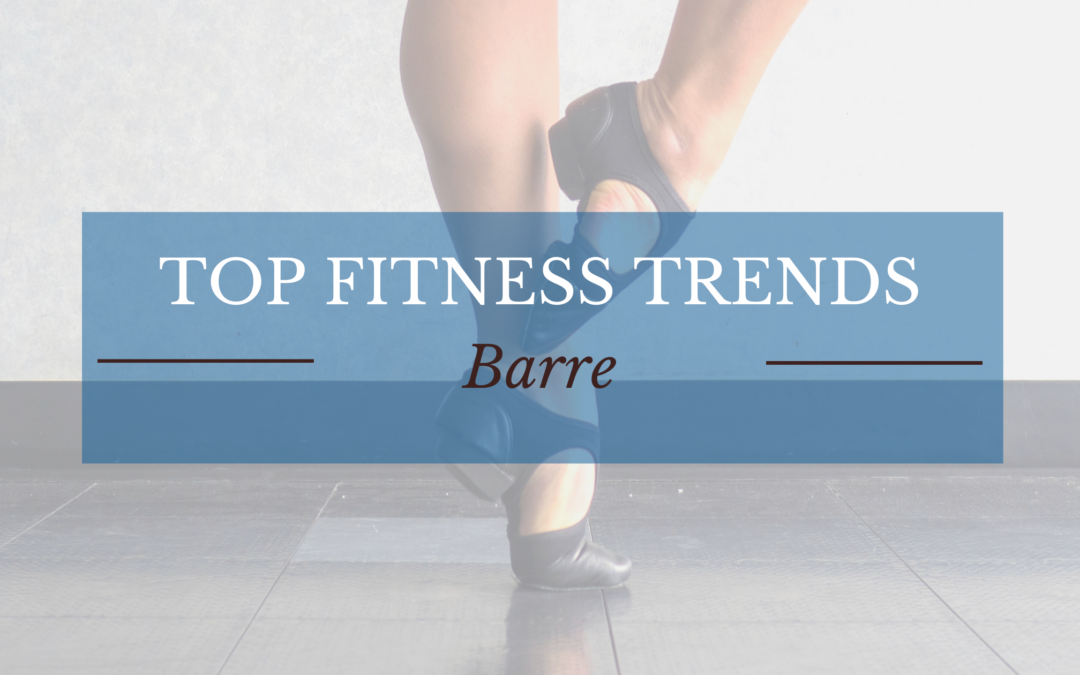
Barre: What is it the fitness trend and is it worth it?

Barre: What is it the fitness trend and is it worth it?

I grew up in a family of dancers. Taking dance lessons until the time I was 8 years old and I’d be lying if I said I still don’t love to dance around from time to time. I think this is the case for a lot of people. Dance is something most people really enjoy letting out some energy with. This is why the popularity of Barre classes have skyrocketed. But is Barre just another fitness trend?

Many people who have a background in dance are looking for that same structure and technique that they are accustomed to with dance classes. Even for those who don’t have a dance background, think dancing is fun. And they are right, it can be a great way to change up your workout routine!

WHAT IS BARRE?

I think many of us have a very vague idea of what Barre is. This was actually started in the 1930s, when Lotte Berk brought it to the public. She was a modern dancer for the time and wanted to bring this kind of exercises that emphasized isometric movements and control for the general public. Many of her dancers at the time had already experienced this, but she wanted to make it widespread so that people of all ability levels could try it.

For today’s world, the class has strayed from a traditional ballet class and has pulled from other popular methods of exercise such as Pilates and Yoga. Making Barre a hybrid fitness trend.

Learn about pilates.

The workouts provided in Barre classes are a challenge. If you have ever seen a ballet or been in a ballet class, you know just how difficult the technique and bodily demands can be. Don’t let this scare you off. The classes are much more tailored to help beginners ease their way into each exercise.

A typical Barre class is set up is by going through each muscle group and burning it out using a series of low impact, but high repetition, exercises. In addition to this muscular endurance work, the class also works in some flexibility training as well.

The important thing to know here that it is not a ballet class. You do not have to be a trained dancer to try it and it is just like starting any other fitness class out there. You will be guided by an instructor the entire time and will get the group workout atmosphere.

WHAT ARE THE BENEFITS OF BARRE?

You may be still wondering why on earth you would do this if you have no background in dance and are just looking for a new workout. There are actually many benefits to doing a workout of this type. Similar to Pilates, this type of workout is going to be mentally engaging as well.

Also placing a big focus on technique, you will have to be heavily concentrated on the task at hand. This may be just the workout you need to get that mental break from your day job.

Barre classes are also a great way to form a community around your workout routine. If you hate working out alone, this might be a great thing for you to try. You can bring along your friends or make new ones a the class.

Not only will Barre be a place for you to bond, but you will have an accountability aspect.

The benefits are not all mental, there are a lot of physical benefits to doing a Barre workout as well. This is another fitness trend that places a large focus on training the core. The benefits associated to Barre are numerous, but perhaps two of the most important are improved posture and balance.

WHAT ARE THE DOWNFALLS OF BARRE AS A FITNESS TREND?

If you have read any of our other fitness trend articles, the drawbacks of Barre might not surprise you.

As we have discussed in previous posts about fitness trends, the improvements in strength from Barre are limited to the weights and reps you use. Because it is often bodyweight or low weight, you are limiting yourself to the muscular endurance phase. There will be limits to how much strength you can build through this kind of workout.

It may not get you to your goals. Similar to a lot of other exercise classes, they are only working in one lane. You are not able to vary your workouts or what phase you are working in because you are confined to the selection of the instructor. This is fine if this is built in to a well-rounded program with cardio and strength, but it is something to consider when planning your week of workouts.

There is little-to no challenge for your heart rate. I am not saying that every workout has to get to the peak of your VO2 Max. However, this does need to be built into your exercise routine in order to improve your cardiovascular health in the long run.

Fit Finds: The Ultimate 2023 Fitness Gift Guide

Fit Finds: The Ultimate 2023 Fitness Gift Guide

Welcome to the world of fitness and wellness gifting! As we gear up for 2023, it's time to start setting goals and looking for resources to help us succeed. Whether you're a fitness fanatic or seeking the perfect gift for one, our Ultimate 2023 Fitness Gift Guide is...

read more
The Power of Social Proof In Personal Training

The Power of Social Proof In Personal Training

In the world of personal training, where trust and credibility play pivotal roles, the concept of social proof functions as an authentic way to connect with your audience. Social proof, the influence created when individuals see others engaging in a particular...
read more
fitness articles
lifestyle articles
nutrition articles
golf articles
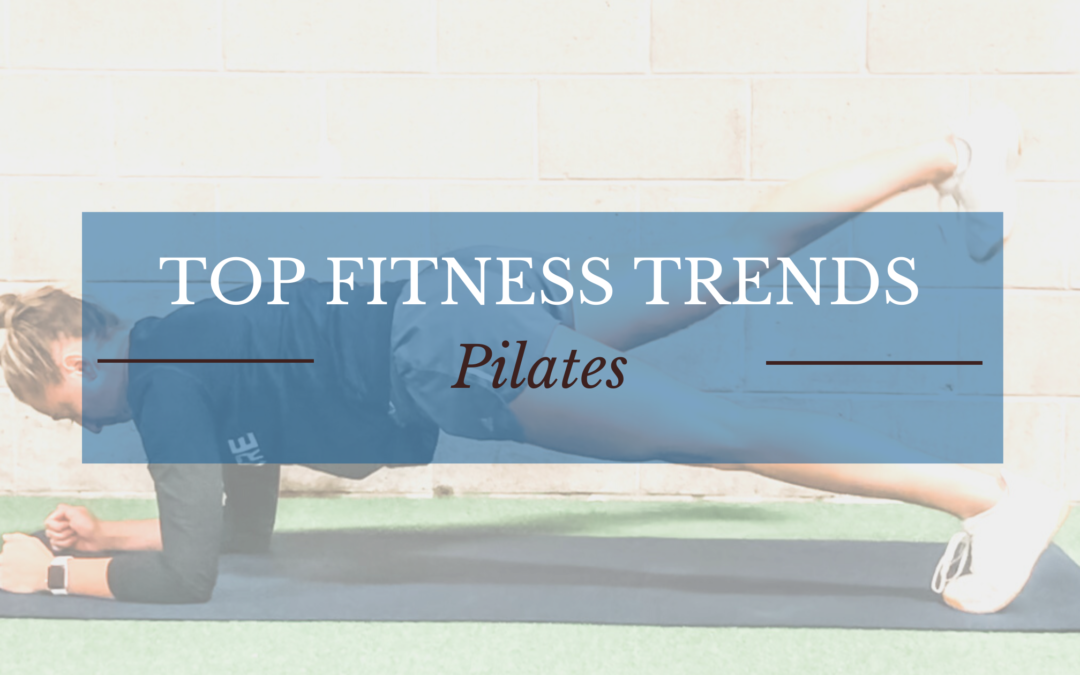
PILATES: WHAT IS IT? SHOULD I BE DOING IT?

PILATES: WHAT IS IT? SHOULD I BE DOING IT?

Just like finding the perfect outfit to wear, picking out the right exercise method to fit your lifestyle and goals is tailored to the individual. Due to people’s different goals and a wide range of interests there are a plethora of fitness classes, trends, and workouts available to the public. HIIT workouts, circuit training, pilates and more.

Exercising is for you and your body to make you feel your best. Just like putting on the perfect outfit! Not only does the exercise method have to match what you want to achieve, but you also have to enjoy it. If you loathe your workout it just gives you an excuse to skip it. It can be tough to find this perfect fit when it comes to exercising. Did you know that your personality plays a huge role is this?

Pilates has been one of the most popular fitness trends not only because of physical benefits, but because of the mental relaxation as well. The question is, is this just a craze? Or is it what you are missing in your workout routine? Let’s dive in and discover a bit more about Pilates.

WHAT IS PILATES?

Although Pilates has really become popular amongst celebrities and gyms everywhere, it has been around since the 1920s. Named after Joseph Pilates who founded the practice, Pilates focuses on specific exercises and movements coupled with a focus on breathing. It also puts emphasis on stretching while developing strength, stability, and balance.

We often talk about how important these factors are in your workout routine. And they become increasingly important as you age. Read more on exercising as you get older.

In fact, “Contrology” was the original name of the practice because of this focus on how you must control your body through breathing and throughout the movements. Many have compared Pilates to yoga, but with more fluidity through each pose or exercise. The biggest focus here is on technique and doing the movements precisely.

Classes usually range from about 45 minutes to an hour and go through a sequence of poses without holding as yoga does. This offers more of a challenge to the body with breathing techniques and engaging almost all of your muscles as you go through many of the poses.

There are different forms of Pilates of which the two most common are Reformer and Mat. Reformer uses equipment such as resistance bands, foot pads, a moving carriage, and straps all on one apparatus. Mat is simply that. It is done on a yoga mat with just your body as you are guided through the exercises. This is generally more accessible to people through video services or at-home Pilates.

BENEFITS OF PILATES

Pilates has a big following because of its’ emphasis on core strength and using body and mind in alignment through the class. Many have seen this as a great transition into the exercise realm when coming from classes like yoga.  There is a large draw to it for these reasons.

Other benefits include the focus on improving posture and flexibility and a big one is that it is a form of low impact training.

As discussed earlier, it is important to find an exercise mode that is suited for your needs and your desires to get active. You should not just focus on why you like it, but why it is beneficial for your body. Evaluate adding Pilates to your workout by deciding if these benefits match your goals. It is also important to look to see if the pros outweigh the cons.

DOWNFALLS OF PILATES

When you look at just the benefits of something it is easy to get a cloudy judgement. On paper, Pilates seems like an amazing way to get active. And it is! But we have to come back to the goals here. If your goal is to drop that number on the scale or see large muscular gains, Pilates may not be for you.

After all, in Pilates you are doing bodyweight exercises. You will not be able to get extreme muscle definition or strength from bodyweight. Even if you add in resistance bands or other equipment seen in reformer type Pilates, you still have a cap as to where your gains can go.

In addition, if weight loss is your goal, Pilates will most likely get you to where you want to be. Incorporating aerobic activity along with strength training will create a more well-rounded workout program. Pilates is a great supplement but doing it as your only form of exercising may not be what your need.

Pilates is a very technical and precise workout. It is not so easy to just jump into an advanced workout without proper knowledge of the exercises and order. This is not uncommon when it comes to different forms of exercises. But when you think of something like a cycling class you can understand the simplicity of hopping on a bike to join a class.

This is not to discredit Pilates, but to ensure that when you are finding the right fit for your workout you consider all the angles!

If Pilates isn’t your thing and you want a more intense form of exercise, maybe circuit training is more your speed. Go at your own pace and pick a couple of exercises to tailor to your time frame.

WHAT NOW?

I would like to emphasize that Pilates has its place in the world and the importance it puts on core and flexibility is spot on. The important things I wanted to bring to light here is that you consider your why when doing a workout. Whatever your reason for working out make sure that is in line with the workout itself, that your are enjoying it, and ultimately it is doing the RIGHT things for your body in the end.

Fit Finds: The Ultimate 2023 Fitness Gift Guide

Fit Finds: The Ultimate 2023 Fitness Gift Guide

Welcome to the world of fitness and wellness gifting! As we gear up for 2023, it's time to start setting goals and looking for resources to help us succeed. Whether you're a fitness fanatic or seeking the perfect gift for one, our Ultimate 2023 Fitness Gift Guide is...

read more
The Power of Social Proof In Personal Training

The Power of Social Proof In Personal Training

In the world of personal training, where trust and credibility play pivotal roles, the concept of social proof functions as an authentic way to connect with your audience. Social proof, the influence created when individuals see others engaging in a particular...
read more
fitness articles
lifestyle articles
nutrition articles
golf articles

SUBSCRIBE

Click to sign-up for weekly information and offers.

DISCLOSURE

We are a participant in the Amazon Services LLC Associates Program, an affiliate advertising program designed to provide a means for us to earn fees by linking to Amazon.com and affiliated sites.