I think this recipe exploded the internet last summer and since then my girl friend and I have been tweaking and perfecting the recipe that we now consider the source of truth for all Grinder Salad to come.. Some of it might be the exact ingredients or maybe it is the...
8 Stretches to Release Tension From Your Desk Job
Stretching is used to help relieve muscle tension. Sitting in the same position for long periods of time, like at a desk, will cause tension to build up in your muscles. That why we have stretches for a desk job, stretches that release the tension you feel from sitting at work.
What to do with a 10- Minute Work Break?
Sitting at a desk all day can be extremely taxing on the body. But wait. You are not actually doing anything, so how could this be harmful? Our bodies actually NEED to keep moving throughout the day. Otherwise, our muscles and joints become stiff and cause pain. We also need to keep blood flowing through our body and our heart working! Previously I discussed just how beneficial taking a break from your desk can be. One of the ways this break can be taken is through stretching.
BENEFITS OF STATIC STRETCHING
All the stretching I have listed below are static stretches. These are stretches that should be held for 30 seconds at the end point of the stretch. They’re beneficial for allowing the muscles to relax into a stretch without entering the stretch reflex stage that cause the muscle to contract and tense up. Stretching, and avoiding the stretch reflex, has been shown to help increase range of motion throughout the muscles and joints in our bodies.
I have listed a couple different exercises that provide a total body stretch. These are designed to release pain in areas that often are tight from sitting at a desk. From your low back, to your shoulders and neck, to even your wrists! Not only are these areas tight from sitting and typing, but can be places where we really hold our stress.
8 STRETCHES FOR TOTAL BODY RELIEF
I realize that not everyone has time for a 10-minute stretch, so I provided 8 stretches that target different muscles. You can choose which ones that you really feel need to be stretched in your own body and fit your time allowance. However, I think you would get the most benefit from doing all of these! It is really important to never stretch to the point of a burn or pain! This will only cause your muscles to tighten more. Stretch until you feel a light tension throughout that muscle!
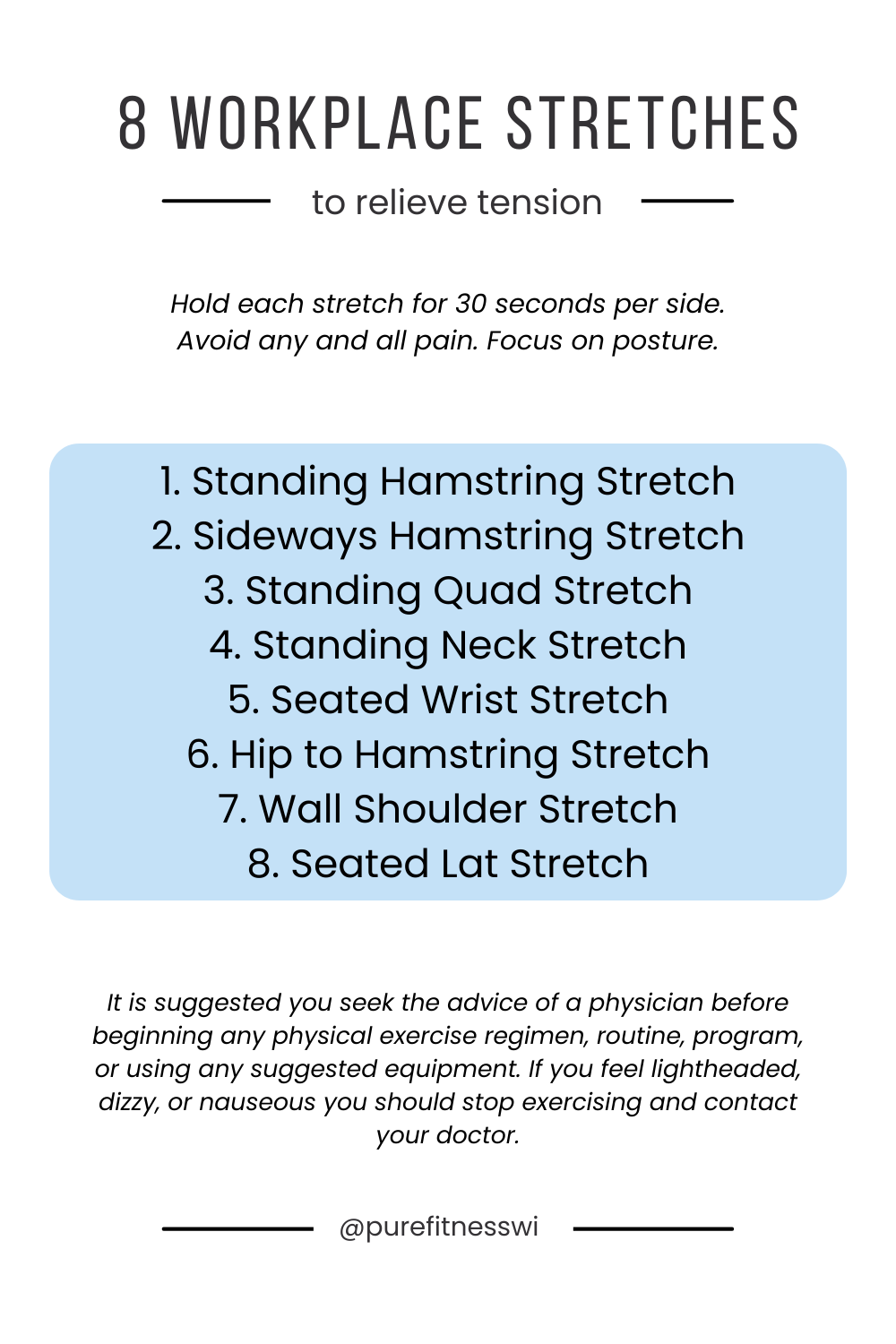
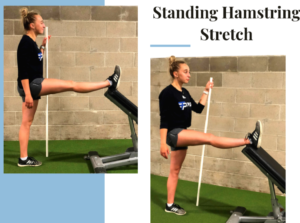
1. Standing Hamstring Stretch
This stretch provides a great release through your hamstring and reduces pain in your low back. Unlike a toe touch, it does not have you bending over, putting strain on your back. It is important to keep your back toe pointing forward & your posture upright. Use a broom stick to help provide extra support and balance! 30 seconds each side // 1 minute total
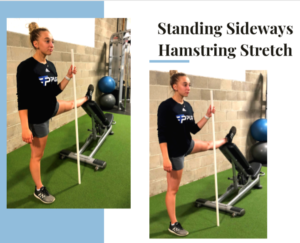
2. Sideways Hamstring Stretch
Similar to the standing hamstring, the sideways hamstring stretch shifts the focus to the inner thigh. This also helps combat low back pain from sitting in a desk chair. Very important to keep the toe of the elevated leg pointing towards the ceiling. 30 seconds each side // 1 minute total
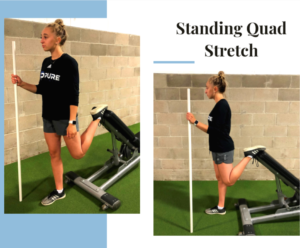
3. Standing Quad Stretch
Focus on maintaining a neutral posture. Specifically, avoid arching at your lower back by keeping your hips tucked under and glutes engaged. The stretch when combined with the two standing hamstring stretches are a great combination in releasing lower back tension. By releasing the tight lower body muscles we can help relieve our lower back. 30 seconds each side // 1 minute total
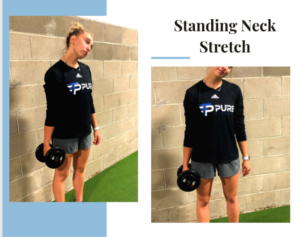
4. Standing Neck Stretch
A lot of people when typing and sitting at a desk get neck and shoulder pain. The standing neck stretch with a resistance can help elongate the muscles of the neck. This will release some of the tension we carry in our neck due to stress as well. Gently bend your neck to move your ear towards your shoulder. Typically a little goes a long way. 30 seconds each side // 1 minute total
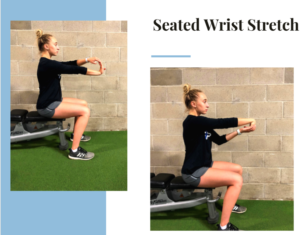
5. Seated Wrist Stretch
This stretch seems really simple, but can open up this joint that is so active in desk work. By pulling our fingers toward our chest, both above and below our wrist we can stretch our wrist and forearms. Doing wrist circles can also help this release. 30 seconds each side, each way // 2 minutes total
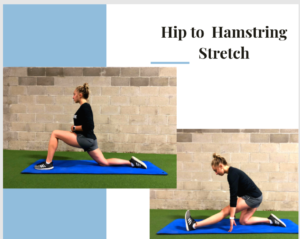
6. Hip to Hamstring Stretch
One of our absolute favorites. This stretch not only provides another great hamstring stretch to relieve tension in the low back, but a good hip flexor opener as well. Sitting at a desk has us keeping our hips in the flexed position. By extending we can release some of that tightness! Remember to keep a neutral spine throughout the movement. Avoid arching in your low back when our front knee is bent. Also avoid excessive rounding in the back when our front leg is straight. 30 seconds each side, each way // 2 minutes total
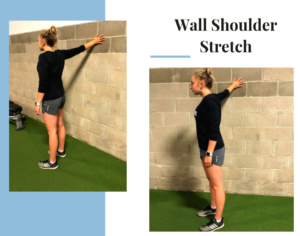
7. Wall Shoulder Stretch
This stretch can release some of the anterior shoulder tension we carry from having our shoulders hunched over at a desk. Using a wall and standing at about a 45 degree angle (or wherever your range of motion is without pain) we can really open up this joint and our chest. 30 seconds each side // 1 minute total
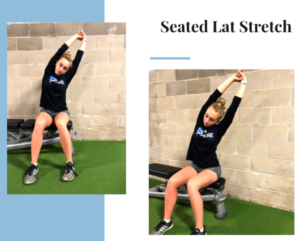
8. Seated Lat Stretch
Commonly overlooked, this stretch allows you to target the latissimus dorsi muscle that stretches down the side of our backs. I love the simplicity of this one because it can be done throughout the day at your desk! Our lats are internal rotators at our shoulders, opening them up will help us open up our chest and fight that rounded “computer posture”. 30 seconds each side // 1 minute total
TAKE A BREAK FOR THESE BENEFITS
Working straight through the day is long, frustrating, and stressful. Taking a couple 5-minute breaks throughout the day can actually help you be better at your job! The American Psychological Association studies have shown that taking breaks is beneficial for mentally focusing on your task at hand. They even suggest watching a dog video, which as you know I love to hear as a dog lover myself.
The same studies done by the APA showed a better attention span, more concentration, and less stressed after taking a break. Still not convinced that you can take those five minutes away from your desk? Maybe one of the suggestions below will entice you enough to take advantage.
HOW TO TAKE A BREAK EFFICIENTLY
The mental benefits are wonderful for improving your work performance. But what do you do for that break to get the most out of it?
- Get outside
- Stretch
- Take your lunch break
- Complete a quick & satisfying task
TAKING AN OUTDOOR WALK
This is my personal favorite! A quick lap around the block or even just stepping outside for a minute to take in a deep breath of fresh air can make all the difference. Being that we live in Wisconsin and it can be extremely cold out. I even like to just open the window/door for a second and feel the fresh air in my lungs. It gives me a lot of clarity. I feel like I get to hit refresh before I start my next task!
If you live in a warmer climate, even sitting outside for a conference call can be refreshing. Or even better, taking a few moments of quiet before a presentation with the warm sun and fresh air can be a unique combination of energizing and calming.
RELEASE SOME TENSION
Do a couple of stretches to release the tightness you feel from sitting at a desk. Standing hamstring and quad stretches can help relieve tension in the lower back that can be caused from sitting at a desk. Shoulder stretches and even stretching your wrists can help those of you stuck typing and hunched over all day.
LUNCH SHOULD BE YOUR BREAK
Don’t just eat lunch, actually take your lunch break! Bringing your lunch back to your desk and continuing to work gives no relief to the stress of the job. Allow yourself to make a balanced, healthy lunch. Refuel and recharge to tackle the afternoon. Mid afternoon exhaustion will only hit you harder if you work throughout the lunch hour.
DO SOMETHING ENJOYABLE
Take time for a task you enjoy! Simple things you can do are petting your dog, watering your plants, read a quick chapter of a book, draw a picture, or even call a friend. Find something you enjoy that can be done quick, especially after you have a stressful phone call or accomplish a difficult task.
Consider even taking a few minutes of stillness. It doesn’t have to be anymore than sitting still and not looking at the phone, computer, TV, to do list, etc. Give your brain a moments rest from the action. I promise you it will feel incredible and you will want to do it everyday … more than once.


Grinder Salad Recipe
read more

How Personal Trainers Can Achieve Financial Independence
Achieving financial independence as a personal trainer isn’t just about working harder—it’s about working smarter. A well-structured business model can be the difference between financial instability and consistent income growth. In this blog, we’ll explore how to...

5 Hacks to Grow Your Fitness Business
For personal trainers, time is often the most valuable yet limited resource. Balancing client sessions, marketing tasks, and business growth can feel overwhelming, leaving little room to focus on growing your reputation and scaling your business. The good news? With...